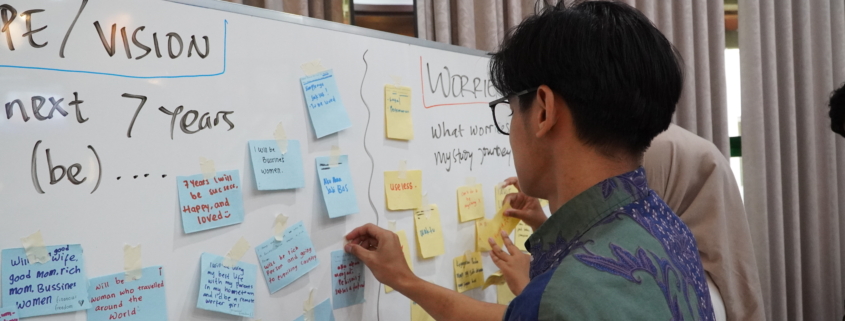
If you’re a Communication Studies student, you’re probably all too familiar with this pattern: the new semester just starts, and suddenly you’re assigned to make a short film. The next semester, it’s time to create a campaign poster or an infographic “for academic purposes.” Not to mention other demanding assignments that have to be executed as meticulously as a real-world production. Sometimes you even find yourself wondering, “Is this college or a production house?”
In the Communication Studies program at UII, this pattern is especially pronounced. Students taking media production or visual communication design courses usually end up shuttling back and forth between the campus’s Audio-Visual Laboratory and the Photography and Multimedia Lab. It’s not just about sitting in class listening to professors lecture on theory—it’s about actually holding a camera, opening editing software, and even figuring out why a single shot needs to be reshot three times.
At first, it sounds like the professors just want to keep students busy. But if you look into it, there’s a pretty solid reason why this approach was chosen, and it’s been discussed for a long time in communication theory.
Come to think of it, why do communication students have to go to the trouble of learning about visuals? One answer is that images also have their own way of conveying messages. Roland Barthes, for example, views images, colors, and symbols as elements that carry meaning and can be interpreted. Donis A. Dondis even coined a specific term for this: “visual literacy,” in his book A Primer of Visual Literacy (1973). The point is, visual literacy isn’t something people are born with—it must be cultivated. And the most effective way to develop it is through hands-on practice, not by memorizing lecture slides.
This is also what makes the learning method feel different from other courses. David Kolb (1984) proposed the theory of experiential learning: learning sticks best through a cycle of direct experience, reflection, conceptual understanding, and then applying it again. That’s why it’s not enough for professors to simply explain theories of composition or color in front of the class. Students must put it into practice right away. Students who’ve worked on assignments like this usually only truly “get it” when the professor asks why they chose a certain color or angle—and the answer “because it just looked good” turns out to be insufficient.
There’s also a practical side to it. Film production and visual design skills are genuinely useful in the professional world—from production houses and creative agencies to corporate branding teams that need campaign materials. Paul Messaris, in his book on advertising (Visual Persuasion: The Role of Images in Advertising, 1997), discusses visual rhetoric; the ability to craft persuasive visual messages is a core skill in many creative industries today. It’s no wonder that UII Communication Studies alumni working in such creative fields often say that the production assignments they completed during college are quite useful once they enter the workforce.
What I think is most important, however, is the audience. Stuart Hall (1973) proposed an encoding/decoding model: a message created by the sender (encoding) isn’t necessarily interpreted exactly the same way by the receiver (decoding). This is what makes filmmaking or design feel so different from writing a paper. A paper is only read by a professor. But a film or poster has to “connect” with an audience who may not understand your background. So students are forced to think from others’ perspectives, not just from their own perspective of what they want to create.
And yes, this is also a matter of the times. People today do grasp messages faster through visuals—films, infographics, short-form content—than by reading long texts. Contemporary media literacy studies have long discussed this. A curriculum that places greater emphasis on visual practice doesn’t mean the communication major has become “less academic”; rather, it’s a way of adapting to the reality of communication today.
So if you’re pulling an all-nighter editing a video or revising a design at 3 a.m. to meet tomorrow morning’s deadline, it’s totally okay to grumble a bit first. But somehow, that’s just part of how communication is taught: you practice first, and only later do you realize its value.
Written by: Ihsandi Rachman
Edited by: Meigitaria Sanita