Tag Archive for: Semiotics

AI

Artificial Intelligence (AI) selalu dianggap sebagai teknologi revolusioner. Menariknya, AI telah diprediksi puluhan tahun lalu oleh teori budaya. Pernyataan ini dibedah dalam International Seminar “Contesting (New) Meanings: AI and Creative Industries” oleh Prof. Kristian Bankov pada 13 Februari 2026 di Gedung RAV Prodi Ilmu Komunikasi UII.

Profesor dari New Bulgarian University itu menyebutkan bahwa kecerdasan buatan modern mencerminkan cara makna selalu bekerja dalam budaya. Dipertegas dengan teori Umberto Eco, seminar ini memaparkan budaya, bahasa, dan kecerdasan buatan semuanya beroperasi melalui jaringan yang dinamis.

Umberto Eco menantang model strukturalis tentang makna, lalu mengusulkan budaya sebagai ensiklopedia. Sistem semantic luas, tanda-tanda memperoleh makna lewat koneksi dengan tanda lain.

“We could consider every cultural unit as emitting given wave-lengths which put it in tune with a limited number of other units and the possibilities of attraction or repulsion change in time,” ucap Kristian Bankov.

Pernyataan tersebut selaras dengan model bahasa AI modern, bukan menghafal makna melainkan menghubungkan statistik kata-kata. “This cycle repeats billions of times, sculpting the landscape into a form that captures grammar, semantics, world knowledge, and reasoning patterns,” tambahnya.

AI tidak menghimpun dan menyimpan bahasa layaknya kamus; AI memetakan bahasa seperti jaringan. Kata-kata berada dalam ruang dimensi tinggi; maknanya muncul dari kedekatan dan konteks. Gagasan Umberto Eco mempercayai bahwa makna bersifat rasional dan dinamis.

Dalam industri kreatif, AI terintegrasi dalam banyak hal, misalnya produksi film, iklan, penciptaan karya tulis, hingga desain grafis. Kristian Bankov menyebutnya sistem generative mendefinisikan sebagai teknologi. “Learn patterns from data and produce content based on those patterns,” ucapnya.

Kreativitas AI berbeda dengan kreativitas manusia, imajinasi manusia bergantung pada pengalaman hidup, emosi, dan persepsi subjektif. Sebaliknya, AI menghasilkan keunikan lewat pola data yang besar. Hasilnya, AI tak menggantikan manusia melainkan partner kolaborasi, kreativitas yang dibantu AI menggabungkan komputasi dengan revisi manusia.

“Restoring a proper balance between the cultural realm and the commercial realm is likely to be one of the most important challenges of the coming Age of Access,” tambahnya.

Kristian Bankov memberikan saran kepada mahasiswa untuk tetap bertanggung jawab dalam menggunakan AI. Meningkatkan literasi adalah inti di era modern. AI bukanlah jalan pintas, hasilnya akan mendalam ketika mahasiswa berinteraksi lewat informasi, bukan hanya pasif. Di tingkat tertentu AI dapat digunakan untuk kritik, simulasi, dan desain penelitian. Selain itu, mahasiswa perlu melakukan verifikasi atas pertanyaan dan jawaban.

“Students should use AI flexibly and responsibly as a supportive learning partner for exam preparation, creativity, and skill development by applying it according to their knowledge level, verifying its outputs, and using it to strengthen understanding rather than just memorization,” tandasnya.

Penulis: Meigitaria Sanita

The Silent Treatment: Why Not Speaking is Also Communication

“Saying nothing sometimes says the most,” wrote Emily Dickinson. In this statement, silence is portrayed not as emptiness, but as a powerful force. It can shape the world and express what words often cannot. While the silent treatment is commonly viewed as passive-aggressive or emotionally manipulative, from a communication and semiotic perspective, silence itself is a sign. This article explores how the silent treatment functions not simply as a breakdown in communication, but as a meaningful form of expression, rich with its own signs, codes, and cultural interpretations.

In semiotics, everything that conveys meaning is considered a sign, including silence. According to semiotic theory, a sign consists of two components: the signifier (the form the sign takes) and the signified (the concept it represents). When it comes to silence, the signifier might be the absence of speech, reflecting disapproval, anger, or anxiety.

The signified, in turn, could be the emotional response to someone’s actions, such as feeling hurt or upset. Silence doesn’t mean “nothing”; like spoken language, it is interpreted within a specific context, carrying layered meanings that can be just as powerful as words.

The cultural context of silence differs from one society to another, as it is shaped by previously learned social codes. In some cultures, silence can be a sign of respect, especially toward elders or authority figures. In others, it may be interpreted as avoidance, rejection, or even punishment. However, in the context of relationships—particularly intimate ones—silence is often seen as a form of emotional punishment or a means of self-protection. Its meaning shifts depending on the cultural and interpersonal framework in which it occurs.

 The Psychological Impact and Intent Behind the Silent Treatment

The silent treatment can have a significant impact, often more than people realize. While it does communicate a message, it frequently causes confusion, emotional distress, or even self-harm in the person on the receiving end. It places a heavy burden on the receiver, who is left to interpret the silence without context, often leading to anxiety or misunderstanding. Sometimes, the silent treatment is used as a defensive mechanism, but it may be perceived as an act of aggression. For this reason, open and direct communication is usually a healthier and more constructive alternative.

Silence may be wordless, but it is never meaningless. As seen through semiotics and cultural contexts, the silent treatment communicates powerful emotions and intentions. While it can serve as a form of expression, it often leads to misunderstanding and emotional harm. Choosing clear, direct communication is a more mindful path toward connection and understanding.

References

contributors, W. (2025, April 8). wikipedia. Retrieved from silent treatment : https://en.wikipedia.org/wiki/Silent_treatment

Golden, B. (2022, september 11). It’s not the same as healthy disengagement. Retrieved from Psychology Today: https://www.psychologytoday.com/us/blog/overcoming-destructive-anger/202209/why-the-silent-treatment-is-such-destructive-form-passive


Written by: Thrya Abdulraheem Motea Al-aqab

Edited by: Meigitaria Sanita

International Workshop

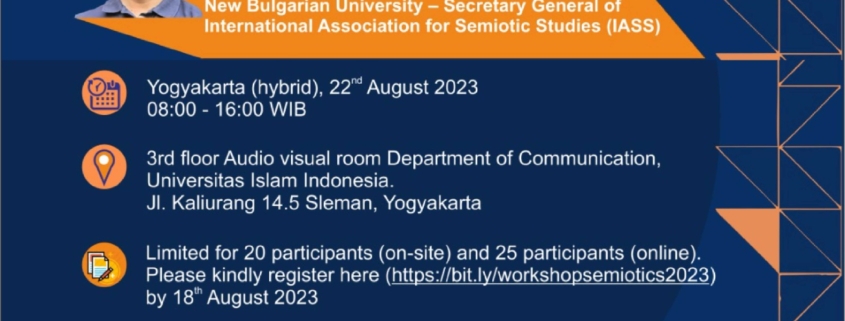
International Workshop “Semiotics of Brands and Consumer Culture”

Speaker: Prof. Kristian Bankov

New Bulgarian University – Secretary General of International Association for Semiotic Studies (IASS)

This one day workshop aims to delve into the application of semiotics as a valuable tool box for critically analyzing the phenomena of brands  and consumer culture. Throughout the workshop, participants will actively engage in examining various brands, advertising, and marketing cases, employing some semiotic models.

The overarching goal of this workshop is to enhance the participants analytical skills in conducting semiotic research on brands and consumer culture. The workshop will be divided into  four parts:

  1. Introduction to applied semiotics in advertising , marketing and branding
  2. Analysis of concrete commercials
  3. Introduction to semiotics of branding
  4. Analysis of local brands using the brand mythology model

Will be held:

  • Yogyakarta (hybrid), 22 August 2023 at 08.00-16.00 WIB
  • 3rd floor Audio Visual Room Departement of Communication, Universitas Islam Indonesia, Jl. Kaliurang  14,5 Sleman, Yogyakarta
  • Limited for 20 participants (on-site) and 25 participants (online). Please kindly register here https://bit.ly/workshopsemiotics2023 by 18 August 2023
  • Free of charge, the participants will get certificate, lunch and coffee break